

Doing the Right Thing at a Community Scale
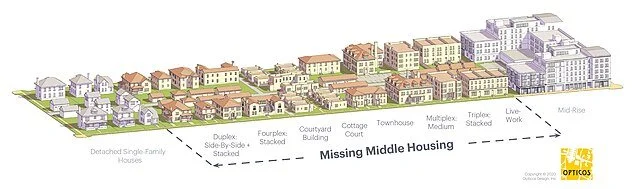
Illustration of Missing Middle housing types between single-family homes and mid-rise apartments. Source: Opticos Design.
Just down the street from my office in Clearwater, Trinity Presbyterian Church made a deliberate decision about its building. Rather than treating sustainability as an add-on or a future goal, the congregation chose to install solar panels across the entire roof of its campus—one of the largest solar arrays in the area.
The decision wasn’t driven by a mandate or a marketing opportunity. It was a values-based choice: a commitment to responsible stewardship, reduced reliance on fossil fuels, and care for the broader community. The result is a building that quietly does its job better—day after day—without asking for attention.
That kind of decision-making is often described as Creation Care, but the underlying principle is widely shared. It’s the idea that we are temporary stewards of the places we build, and that thoughtful choices—made early and made well—can have lasting positive effects.
What struck me most about Trinity’s project is how transferable the idea is. The same mindset that leads a congregation to invest in rooftop solar can also guide how we think about land use, housing, and neighborhood-scale development.
Stewardship Beyond Buildings
My interest in stewardship—environmental and otherwise—isn’t theoretical. I’ve been an active member of the Florida Green Building Coalition for many years, alongside involvement in other professional sustainability-focused architecture groups.
Earlier in my career, I also volunteered with Habitat for Humanity on a green, eco‑friendly infill home in Washington, DC around 2000–2001. That project left a lasting impression on me: it demonstrated that thoughtful, energy-conscious design was achievable even with modest budgets and tight urban sites.
Outside of professional practice, I’m also a gardener with a particular interest in native Florida plants. Gardening has reinforced many of the same lessons I see in architecture—working with local conditions, respecting limits, and understanding that long-term success depends on thoughtful early decisions.
When sustainability is discussed, it’s often framed at the scale of individual buildings—energy efficiency, materials, operating costs. Those things matter. But some of the most meaningful environmental and social impacts happen at a larger scale: how land is used, where housing is located, and how communities grow over time.
Development decisions influence transportation patterns, infrastructure demands, access to jobs and services, and long-term affordability. In that context, stewardship isn’t just about what we build—it’s about where and how we build.
This is where housing quietly becomes a Creation Care issue.
From Rooftops to Neighborhoods
The choice Trinity Presbyterian made with solar panels is comparable to a choice communities face with housing. Instead of expanding outward—consuming more land, extending infrastructure, and increasing car dependency—we can choose to make better use of what already exists.
This approach is sometimes referred to as YIGBY—Yes In God’s Backyard—a phrase used to describe faith-based support for thoughtfully adding housing on underutilized land, often near churches, schools, and neighborhood centers. While the term has faith-based roots, the underlying idea translates well beyond any single tradition: using land responsibly to meet real community needs.
At its core, this is about:
Using land responsibly
Supporting diverse households and life stages
Strengthening neighborhoods without overwhelming them
Reducing environmental impact by building near existing services and infrastructure
It’s not an argument for large-scale or disruptive development. It’s an argument for appropriate development.
The Role of Missing Middle Housing
Missing Middle housing—duplexes, triplexes, quads, townhomes, and small apartment buildings—offers a practical way to put these values into action.
In practice, this often looks like:
A duplex or triplex on a lot currently occupied by a single home, designed to match the surrounding scale
A small courtyard-style apartment building replacing an underutilized commercial or institutional site
Townhomes on infill parcels near transit, jobs, or neighborhood centers
Housing developed on excess land owned by congregations, schools, or nonprofits
These housing types:
Fit comfortably into existing neighborhoods
Support walkability and shorter commutes
Provide more attainable housing options
Make efficient use of land and infrastructure
Scale naturally, without the impacts of high-rise development
For faith-based organizations, nonprofits, and small-scale developers, Missing Middle housing can align mission with feasibility. It allows communities to respond to real housing needs while remaining good neighbors.
From an environmental standpoint, these projects often have a smaller footprint per household and lower long-term energy and transportation impacts. From a social standpoint, they support multi-generational living, workforce housing, and aging-in-place—all critical needs in our region.
Architecture as a Translating Tool
Good intentions alone don’t make good development. Architecture plays a critical role in translating values into built form.
In concrete terms, thoughtful design decisions might include:
Keeping buildings to two or three stories to respect neighborhood scale
Using familiar materials and roof forms while updating layouts and performance
Designing shared outdoor spaces that feel safe, usable, and inviting
Orienting buildings for daylight and cross-ventilation
Integrating native landscaping to reduce water use and maintenance
In Missing Middle and community-scale projects, success often comes down to details—how buildings meet the street, how parking is handled, how privacy is balanced with connection.
This is where experience with infill, multifamily, and small-scale development matters.
Doing Better, Not Just More
What connects a solar-powered church and Missing Middle housing isn’t ideology—it’s intention.
Both represent a choice to think long-term. To invest in solutions that quietly serve people, neighborhoods, and the environment over decades rather than years. To align values with practical action.
Good development doesn’t have to be loud. Often, it simply does the right thing—consistently and well.
At Design Freedom, Inc., we’re interested in working with clients who share that mindset: congregations, nonprofits, and small-scale developers looking to create housing that fits its place and serves real community needs.
Sometimes stewardship starts with a roof. Sometimes it starts with a neighborhood. Either way, the impact can be lasting.
A Conversation Worth Having
If you’re part of a congregation, nonprofit, or development team exploring how land, buildings, or housing can better serve your community, I’d welcome the conversation. Thoughtful projects often begin not with a finished plan, but with shared values and the willingness to ask good questions.
You can learn more about our work—or reach out to start a discussion—at DesignFreedomInc.com.