

The Missing Middle Problem Starts with Zoning
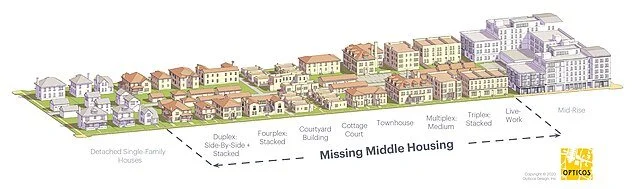
Missing Middle housing types, from single-family homes to mid-rise apartments, as seen in historic Gulfport and Saint Petersburg. Source: Opticos Design.
What We Were Taught
When I was studying to become an architect, I always knew I wanted to design homes. But I was also fascinated by the bigger picture—the way cities are laid out, how buildings relate to each other, and how people move through the built environment.
So I took classes in urban planning, and one of the first things we learned was how zoning began.
Zoning didn’t start as a bad idea. Quite the opposite.
In places like London during the industrial revolution, massive factories were being built right next to homes and rowhouses. These factories produced smoke, noise, and pollution—and often contaminated the same waterways people relied on for drinking water.
Zoning was introduced as a way to separate uses and protect public health. It was meant to create order, safety, and a better quality of life.
And in many ways, that made perfect sense.
Beyond separating uses, we were also taught something more intuitive about how cities naturally develop.
Along major roads, you tend to see more buildings. At key intersections—especially where roads connect multiple towns—development intensifies. You might find shops, restaurants, offices, and even hotels. As activity increases, so does building size and density.
Then, as you move away from those intersections, things begin to scale down:
Large buildings become smaller
Density decreases
Buildings spread farther apart
Eventually, you transition into neighborhoods of single-family homes—and beyond that, into open land or farmland.
This gradual transition supports walkability, concentrates traffic where infrastructure can handle it, and buffers busy areas from quieter homes. It’s a logical, human-centered way to shape the built environment.
What We Actually Build
If you look at development patterns today—especially in areas like Saint Petersburg—you’ll often see something very different.
Sometimes, large intersections don’t have much density at all.
Other times, large buildings appear far from any traditional center, seemingly placed wherever land was available or inexpensive. Big box stores, for example, are often located outside of downtown areas, where land is cheaper and easier to develop.
Meanwhile, older downtowns—where density would make the most sense—can be difficult and expensive to build in due to limited space, higher land costs, and regulatory constraints.
The result? A built environment that often feels disconnected from the logic we were taught.
The Missing Middle—Excluded Entirely
To be specific, in many areas, zoning for housing tends to fall into two categories:
Single-family neighborhoods
Multi-family districts
But there’s often very little in between.
When multi-family housing is allowed, it tends to be built at a much larger scale—large apartment complexes, taller buildings, and higher unit counts. From a development standpoint, that makes sense. It’s often more efficient to build one large building than several smaller ones on individual lots.
Historic areas provide a contrast. In cities like Charleston, New Orleans, and even older parts of Saint Petersburg, you’ll often find a finer-grained mix:
Single-family homes
Duplexes that look like single-family houses
Triplexes and quadplexes tucked into the block
Small, two-story garden apartment buildings with a handful of units
Sometimes you don’t even notice the difference at first glance—and that’s part of why they work so well.
Whether it’s zoning, construction efficiency, or financing realities, these middle housing types are largely missing today. It’s often easier to get funding for a single-family house or a very large apartment building than for something in between. That’s beyond the scope of this article, but it’s a real part of why the missing middle has disappeared.
Why This Is a Problem
I’ll be honest—I grew up in suburbia, and I still live in suburbia. And I like it.
But the version of suburbia I value is one where things are still within reach.
When I was younger, I could bike through a couple of neighborhoods and, within about half an hour, be at a grocery store or a restaurant. Today, I still live within about a 20-minute bike ride of a large shopping area, along with several grocery stores and restaurants. I choose to bike more in the cooler, drier months—and less during the hot, humid summers—but I appreciate having the option.
It’s quieter than a downtown. It offers space. And for many people, that balance is ideal.
At the same time, I recognize that everyone prefers something different.
Some people love living in an urban core. They want to walk everywhere. They’re comfortable with smaller living spaces because they have access to parks, shops, and activity just outside their door.
Others prefer to live farther out. They may want more land, more privacy, or simply a deeper connection to nature.
There isn’t one “right” way to live.
For many people, suburbia was sold as an ideal:
Better schools
Safer streets
More space
But in reality, many suburban neighborhoods come with tradeoffs we don’t always talk about.
Children often can’t walk or bike safely to school. Daily life requires driving—even for simple errands. Neighborhoods are often poorly connected, with few sidewalks, dead-end streets, and no easy way to move between adjacent areas.
Over time, these patterns became the norm. Developers built according to market expectations, regulations, and what had been done before—and often repeated the same model without thinking intentionally about the community they were creating. Decisions were made for efficiency or simplicity, not necessarily for how people actually live or how neighborhoods could thrive over decades.
Intentionality matters. When we design neighborhoods thoughtfully, we consider:
How families move through their neighborhood
Where people can walk or bike safely
How different types of housing coexist
How public spaces connect everyone
Without that, we end up with disconnected streets, neighborhoods that require driving for every errand, and housing that doesn’t reflect the variety of real households.
By focusing on intentional design today—whether it’s mixed-use buildings, missing middle housing, or adaptable streetscapes—we can create communities that meet real human needs. It’s not about preventing growth or criticizing developers—it’s about making sure development reflects what we value, so neighborhoods work for everyone, now and in the future.
When we only allow single-family homes in one area and large apartment complexes in another, we lose the ability to create balanced, connected communities. That “in-between” is the missing middle—and it’s where a lot of life actually happens.
It might include:
Townhomes along a busier street
Small apartment buildings a few blocks from single-family homes
Accessory dwelling units (ADUs) near larger houses
Assisted living integrated into neighborhoods
These patterns reflect the diversity of real households: singles, young couples, families with children, multi-generational households, and aging adults. When housing is one-size-fits-all, communities can’t adapt—and families can’t stay connected.
What Needs to Change
In many ways, we already understand what works.
It makes sense to place larger buildings—apartment buildings, offices, mixed-use structures—closer to busy roads and major intersections. These areas are best equipped to handle traffic, access, and activity.
Then, as you move away from those areas, the transition can happen gradually:
Smaller apartment buildings
Townhome neighborhoods
Duplexes and triplexes integrated into single-family areas
Accessory Dwelling Units (ADUs) throughout
This kind of progression isn’t new. It’s how many places were built before zoning became so restrictive.
It also makes sense to allow for more flexibility within buildings themselves. Not every household looks the same, so why should every unit be the same?
A single building could include:
One-bedroom apartments
Two-bedroom units
Larger three- or four-bedroom homes
Just because someone has a larger family doesn’t mean they want—or can maintain—a large yard. That’s not everyone’s lifestyle or priority.
Life changes. Aging parents, adult children returning home, or family members with special needs all need housing options nearby. Zoning can support these needs—it just needs to be written to allow them.
In Tampa Bay, some flexibility already exists:
Single-family zoning districts often allow heights up to 35 feet, based on the residential building code, which allows up to three stories (around 30 feet) without moving into the commercial building code
In flood zones, height is measured from base flood elevation rather than ground level, allowing taller buildings while remaining residential
We don’t need to reinvent the wheel. Communities like Seaside show that thoughtful planning, mixed-use design, and walkable layouts work—and these ideas can be applied in modern zoning.
Local Examples and Opportunities
Local examples in Pinellas County—cities like Gulfport, St. Petersburg, Safety Harbor, Dunedin, Clearwater, and Palm Harbor—illustrate both the challenge and the opportunity. While suburban growth has blurred the boundaries between these cities, the small downtown cores remain vibrant and attractive.
Introducing more housing into these areas will inevitably face pushback. Many long-time residents value detached single-family homes near the walkable downtown. But historically—and in some cases still today—these downtowns included buildings with shops on the ground floor and apartments above. Promoting this mixed-use pattern, along with small apartment buildings, duplexes, triplexes, and other missing middle options around downtown cores, could support thriving, connected communities.
These areas are already popular destinations, with weekend festivals, street closures, and lots of locally owned shops and restaurants. Supporting diverse housing here is a challenge worth having.
We also have what I like to call “accidental downtowns.” These are shopping malls or centers that were built with a high density of shops and restaurants, but almost no housing integrated into them. Naturally, they require huge parking lots because everyone has to drive to reach them.
But these accidental downtowns present an interesting opportunity. With some thoughtful planning and zoning adjustments, they could evolve into true urban cores—integrating housing, offices, and public spaces alongside the existing shops. They could become vibrant, walkable places that serve the community in ways they currently do not.
Looking Ahead
If you're exploring small-scale development or rethinking how a property could be used,
visit DesignFreedominc.com
Whether you're considering a duplex, townhomes, or a small multi-family project, these are the types of housing that can help fill in the missing middle and create more connected, livable communities.
Even if you're just starting to think about what’s possible, understanding how zoning works—and how it could work differently—is the first step.