

Before You Buy a Property: How a Feasibility Study Reveals What You Can Actually Build
Most real estate investors evaluate a property the same way they always have—price, location, and comparable sales.
That works well when you’re buying and selling existing buildings.
But the moment you start thinking about new construction or redevelopment, the conversation changes completely.
Because at that point, the question is no longer “Is this a good property?”
It becomes: “What can this property actually support once we apply zoning, flood rules, setbacks, parking requirements, and real-world constraints?”
And those are very different things.
This is where a Feasibility Study comes in.
It’s not design. It’s not architecture in the traditional sense. It’s the step before all of that—the part where we figure out whether the idea and the property actually align before you commit to purchasing.
The first thing that usually surprises people
One of the biggest surprises for most investors is that a property rarely “feels” as constrained as it actually is.
On paper, it might look large enough for four units or a duplex with generous parking or even a small townhouse project.
But once we start applying the actual rules—zoning, setbacks, parking requirements, flood elevation, and site access—that perceived space starts to shrink very quickly.
What looked like a simple “this should work” property can turn into something much more limited once all the constraints are layered together.
And in other cases, the opposite happens. A property that doesn’t initially look very promising can actually support more than expected once you understand how the rules interact.
That’s the value of doing this early.

Coastal Duplex project on Indian Rocks Beach - living space above parking
In Florida, flood zones usually come first
Here in Florida, especially in coastal areas, we often start with flood zones before anything else.
Not because zoning isn’t important—but because flood regulations can immediately define the entire approach to the project.
Most people think of flood zones as simply “in or out.” But that’s not really how it works.
Flood Zone X is generally considered low risk, but everything else introduces requirements that affect how a building must sit on the land.
In many cases, the solution becomes fairly consistent: living space goes up, and parking or open space goes down below.
Once that happens, the entire project starts to take on a completely different shape than a typical ground-level building.
Zoning doesn’t just control use—it controls size
Once flood conditions are understood, we move into zoning.
And this is where things often become much more complex than people expect.
Zoning determines what you’re allowed to build, yes—but it also quietly determines how much you’re allowed to build.
It controls density, setbacks, building height, and sometimes even parking requirements.
And when you start combining all of those together, you realize something important: zoning doesn’t just tell you what fits legally—it determines what fits physically.
We often find that once all the rules are applied, the usable building area is significantly smaller than what the property appears to offer at first glance.
That directly affects how many units are possible, and just as importantly, how large those units can realistically be.
Zoning also often includes two additional controls that investors rarely pay attention to at first: Floor Area Ratio (FAR) and Impervious Surface Ratio (ISR).
FAR limits the total building square footage relative to the size of the lot. ISR limits how much of the site can be covered by impervious surfaces like buildings, driveways, parking areas, and sometimes even patios.
On paper, a property might seem large enough for a certain project, but these two numbers quietly determine how much of that site can actually be built on—or paved over. They can significantly reduce what is possible once everything is calculated together.
One other factor that is just as important—but often overlooked entirely at the beginning of the process—is how the property is allowed to be rented.
Before investors even get into design or feasibility studies, it is worth confirming what the actual rental rules are for the zoning district and jurisdiction. In some areas, rental use is very limited. We occasionally see properties where rentals are restricted to family members only, which obviously changes the entire investment model.
More commonly, especially in coastal and tourist-driven markets like much of Florida, the issue is not whether you can rent—but how long each rental period must be.
Some jurisdictions allow nightly rentals. Others require minimum stays such as 7 days, 30 days, 6 months, or even longer. These rules vary widely not just between cities, but sometimes between zoning districts within the same municipality.
And importantly, these rental restrictions often determine whether a project concept works at all. A layout that performs well as a short-term vacation rental may not work at all as a long-term rental, and vice versa.
Because of that, this is one of the first things we encourage clients to confirm before moving too far into design or even before commissioning a feasibility study. It can immediately clarify whether a property aligns with the intended investment strategy.
In other words, before we ever design a building, we have to understand how the property is legally allowed to operate.
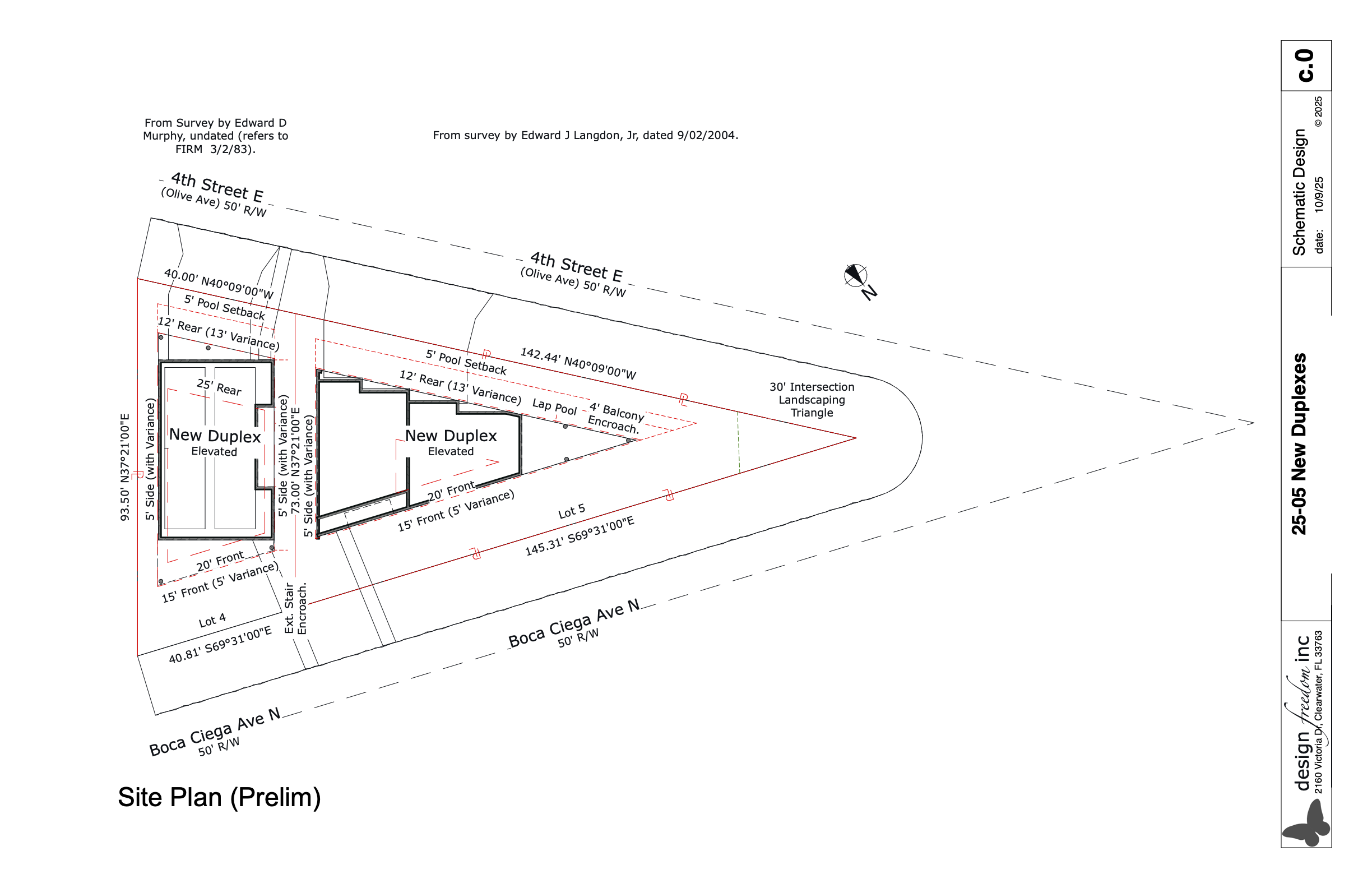
Schematic Site Plan showing property lines, setback lines, buildings and driveways
Parking and setbacks are where projects often disappear
If flood zones and zoning define the overall envelope, parking and setbacks tend to define the actual usability of the site.
Setbacks don’t just push the building inward—they also affect where parking can go, where outdoor spaces can exist, and how the building connects to the site.
Parking requirements can be just as impactful. Depending on the jurisdiction, the number of required spaces, their size, and even their location on the site can completely change the layout.
Then there are all the smaller but very real details people don’t expect: roof overhangs, stairs, decks, and mechanical equipment like air conditioning units and pool pumps.
Some jurisdictions allow these to extend into setback areas. Others don’t.
None of these rules seem dramatic on their own, but together they often determine whether a project is easy, difficult, or sometimes even possible at all.
Knowing your target tenant changes everything
At some point in this process, we also have to talk about who the project is actually for.
Because that decision affects everything.
A working family renting long-term will prioritize very different things than a short-term vacation renter. One may care more about bedrooms and storage and practical layout. The other may care more about open entertaining space, bathrooms, outdoor areas, and overall experience.
And here’s where it ties directly back to feasibility:
Even if zoning allows a certain number of units, it doesn’t guarantee those units will be large enough—or configured in a way—that supports your intended market.
We often end up estimating something very practical at this stage. For example, a site might realistically support units around 1,000 square feet, or perhaps closer to 1,600 square feet.
That difference completely changes what type of project makes sense.
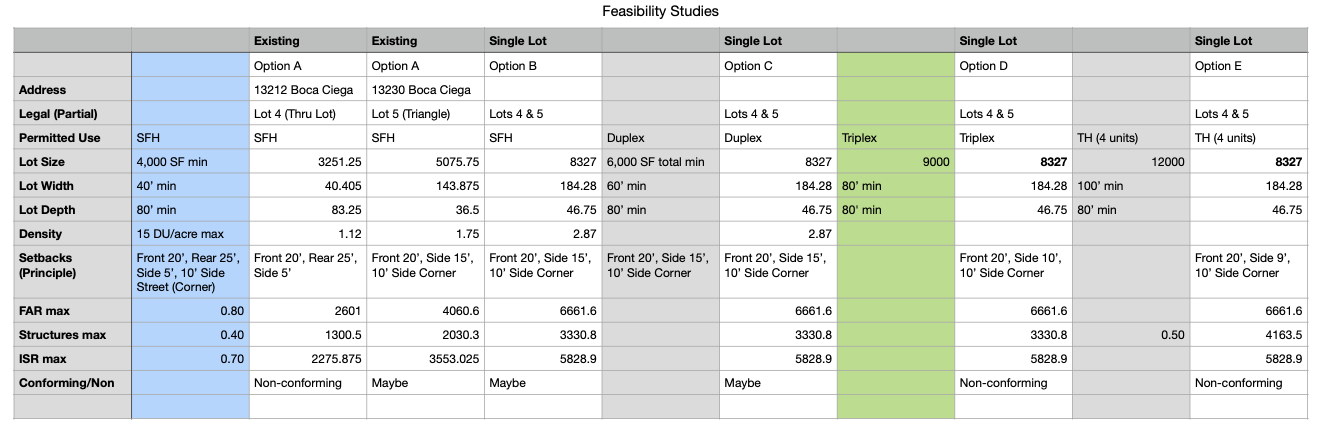
Chart showing Feasibility Study options based on Zoning Code
From abstract rules to a physical building
Once we understand all of those constraints together—flood requirements, zoning, setbacks, parking, likely unit size, and rental limitations—we can finally start testing what might actually fit.
That’s when we begin early schematic thinking.
Where does the building sit on the site?
How does parking work?
Does it need to be one story, two stories, or more?
What does elevation do to the overall form?
At this point, the project starts to shift from a set of regulations into something you can actually see.
And that’s usually when clients begin to understand whether the opportunity is real—or just theoretical.
A real example: Post-hurricane redevelopment in Pinellas County
One project we worked on in 2025 involved two adjacent lots on one of the barrier islands in Pinellas County.
After the severe hurricane flooding in 2024, many properties along the coast had to be reevaluated because they exceeded FEMA’s substantial damage threshold. In some cases, the existing structures could no longer simply be repaired and had to be considered for full redevelopment.
This particular site was unusual. It consisted of two triangular-shaped lots with older duplex buildings, originally built decades ago, and used as short-term rentals.
The combination of flood requirements, outdated construction, and irregular lot geometry created a complex puzzle.
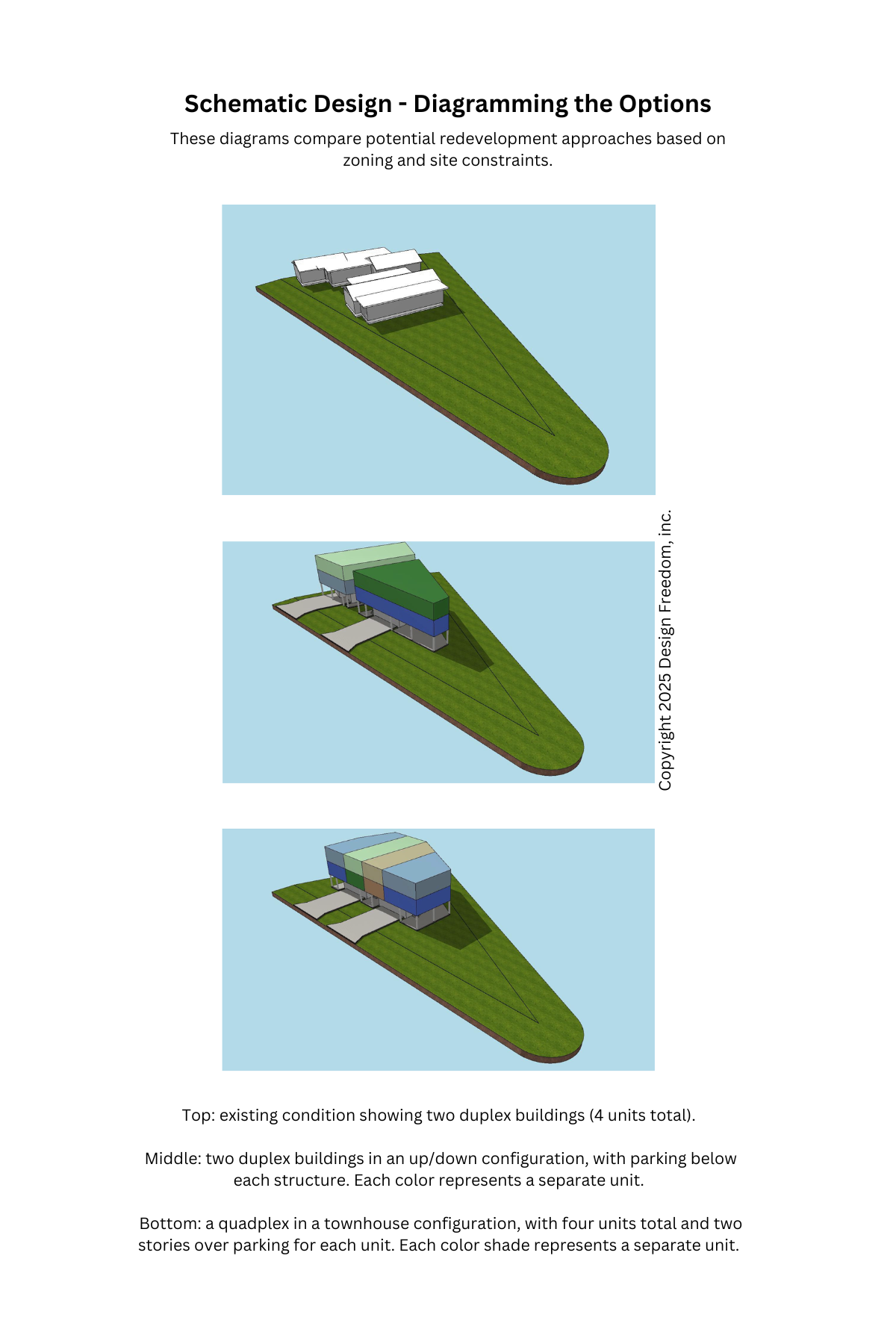
We explored several options—keeping the lots separate, combining them, rebuilding duplexes, and even looking at more intensive multifamily or townhouse-style concepts.
We also worked closely with the local jurisdiction early in the process to understand how a variance request might be viewed, especially given that the surrounding neighborhood still reflected many of the older, non-conforming setback conditions.
Ultimately, we developed several schematic options showing different approaches, with unit sizes generally ranging from about 1,200 to 1,600 square feet above parking.
At that scale, the units could function well as either compact three-bedroom layouts or more typical two-bedroom vacation rentals.
The variance was ultimately approved, and the project was technically feasible.
But even with approval, the client ultimately decided the economics no longer made sense and chose to sell the property.
And that’s an important point.
A successful feasibility study doesn’t always lead to construction.
Sometimes the best outcome is simply knowing when not to proceed.
The real purpose of a Feasibility Study
At its core, a Feasibility Study isn’t about design.
It’s about clarity.
It connects the rules of zoning and flood regulations with the physical reality of a site and the financial reality of a project.
Before drawings.
Before engineering.
Before major investment.
It helps answer the question that really matters:
Does this property actually support what I want to build?
And if not, it’s better to know that before you buy it.
If you’re considering purchasing a property for a small-scale development, redevelopment, duplex, or missing middle housing project, a Feasibility Study can help clarify what is realistically possible before you commit to a purchase.
It provides a clear understanding of what the site can actually support—before you move forward with design or investment decisions.
If you’d like us to take a look at a specific property, feel free to reach out and we can walk you through the process.