

Before You Buy: What Zoning Really Controls in Property Development
When investors first look at a property, zoning often feels like a simple yes-or-no question.
Can I build here, or can’t I?
But zoning is not just permission. It is a framework that quietly defines the physical limits of what a property can actually become.
Before you ever get to architectural design, engineering, or even financial modeling, zoning is already shaping the outcome.
And most of the time, it is doing that in ways that are not immediately obvious from a listing, a parcel map, or even a walk through the site.
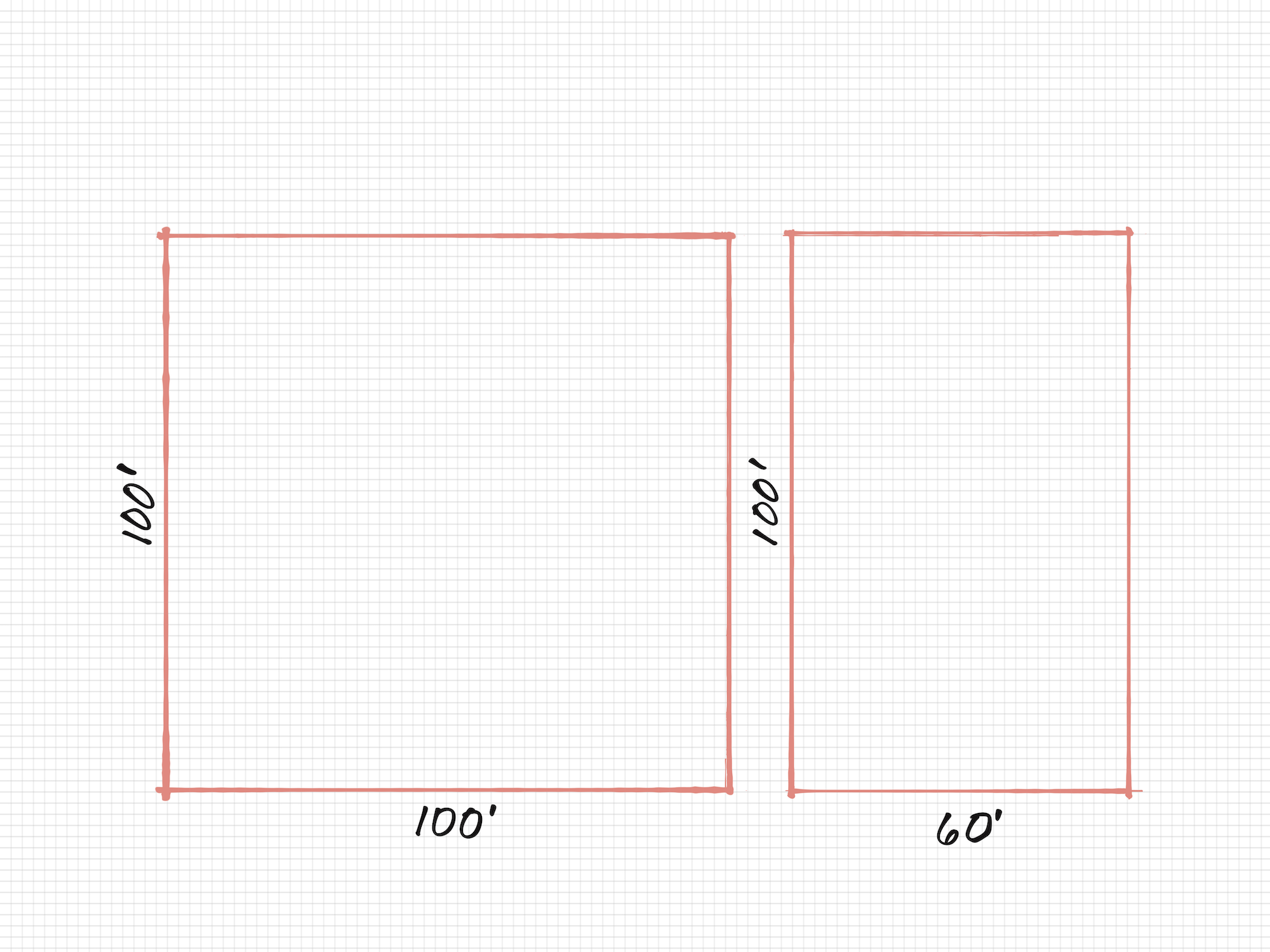
The legal boundaries of a property shown as a 100’x100’ large lot and a 60’x100’ small lot.
Zoning is not one rule—it is a system of constraints
Zoning is often thought of as a single designation: single-family, multifamily, commercial, and so on.
But in practice, it functions as a layered system of rules that all work together at the same time.
It controls what you are allowed to build, but also how much you can build, where it can sit on the site, and how it relates to the surrounding context.
That includes:
What type of use is permitted (residential, multifamily, mixed-use, etc.)
How many units are allowed on a property
How tall a building can be
How far the building must be set back from property lines
How much parking is required and where it can be located
Individually, each rule seems manageable. But once they are applied together, they begin to define a very specific buildable envelope for the site.
That envelope is often much smaller than what people initially assume the property can support.
Density is only the starting point
One of the first things investors look for is density—how many units are allowed per acre or per parcel.
But density alone does not determine what can actually be built.
A zoning district might technically allow multiple units on a property, but that does not guarantee those units will fit in a practical or financially viable way once setbacks, parking, and other requirements are applied.
In other words, zoning might allow a duplex, triplex, or even a quadplex, but the real question is whether the site can physically support that program once everything else is accounted for.
This is where many assumptions start to shift.
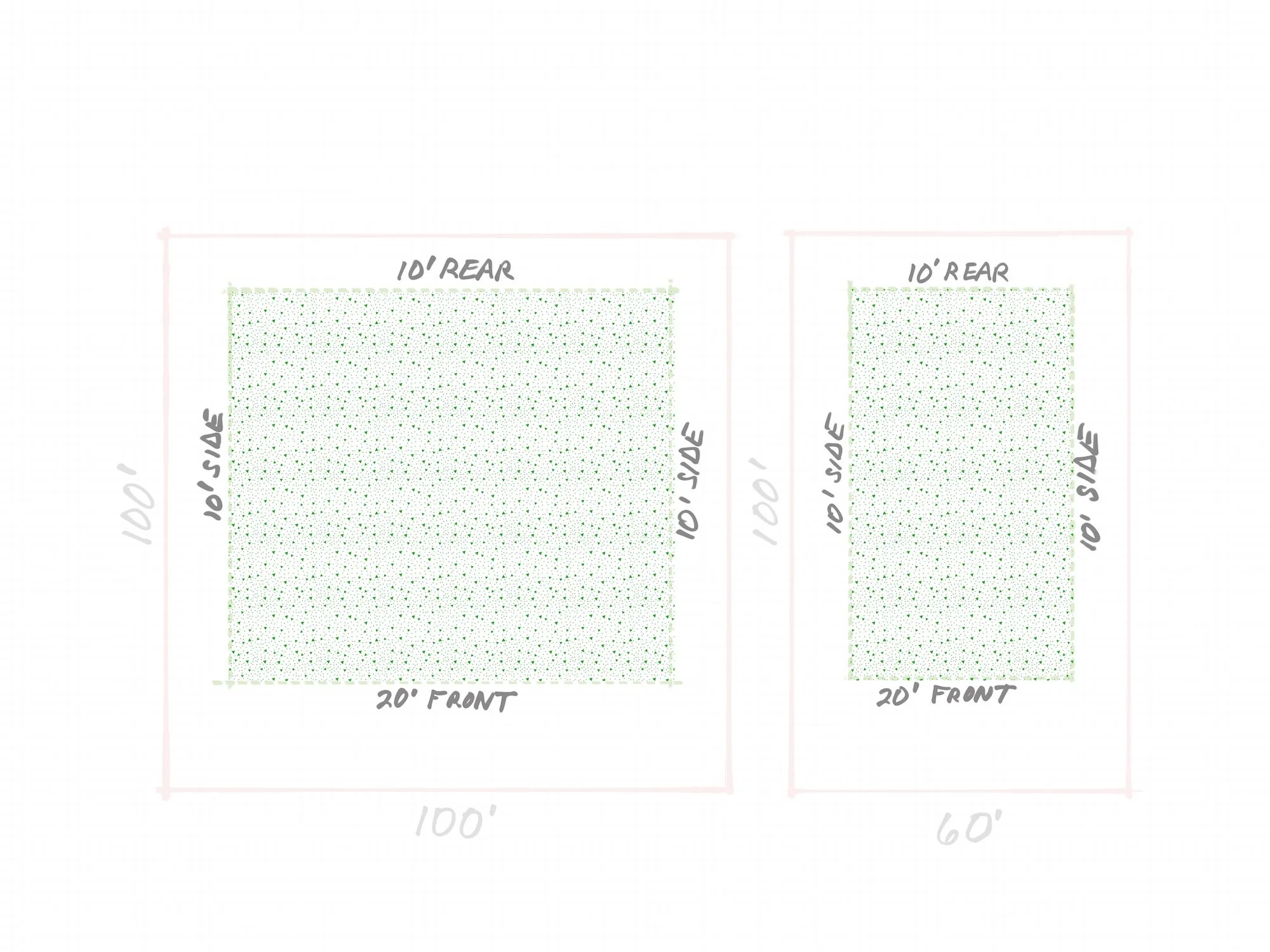
The buildable area of each of these 2 lots is shown shaded green while each property is outlined in red.
Setbacks quietly define the real building area
Setbacks are one of the most underestimated parts of zoning.
They define how close a building can be to the front, side, and rear property lines.
On paper, they may look like simple buffer requirements. In reality, they often determine the actual footprint of the building more than anything else.
Once setbacks are applied on all sides of a site, especially smaller or irregularly shaped parcels, the remaining buildable area can shrink significantly.
This is one of the first moments in a feasibility study where a property starts to reveal its true potential.
Not what it is, but what is actually left after the rules are applied.
Zoning also controls height—but not always in a simple way
Most zoning codes include a maximum building height, often expressed in feet or stories.
At first glance, this seems straightforward.
But height limits are often influenced by other factors, including flood elevation requirements in coastal areas. In some cases, the “measured from grade” definition changes depending on site conditions, which can significantly affect how many usable floors are possible.
A property that appears capable of supporting three stories may, in reality, only function as two stories once elevation requirements and access conditions are applied.
This is especially important in coastal Florida, where elevation and flood compliance often define the overall building form before anything else.
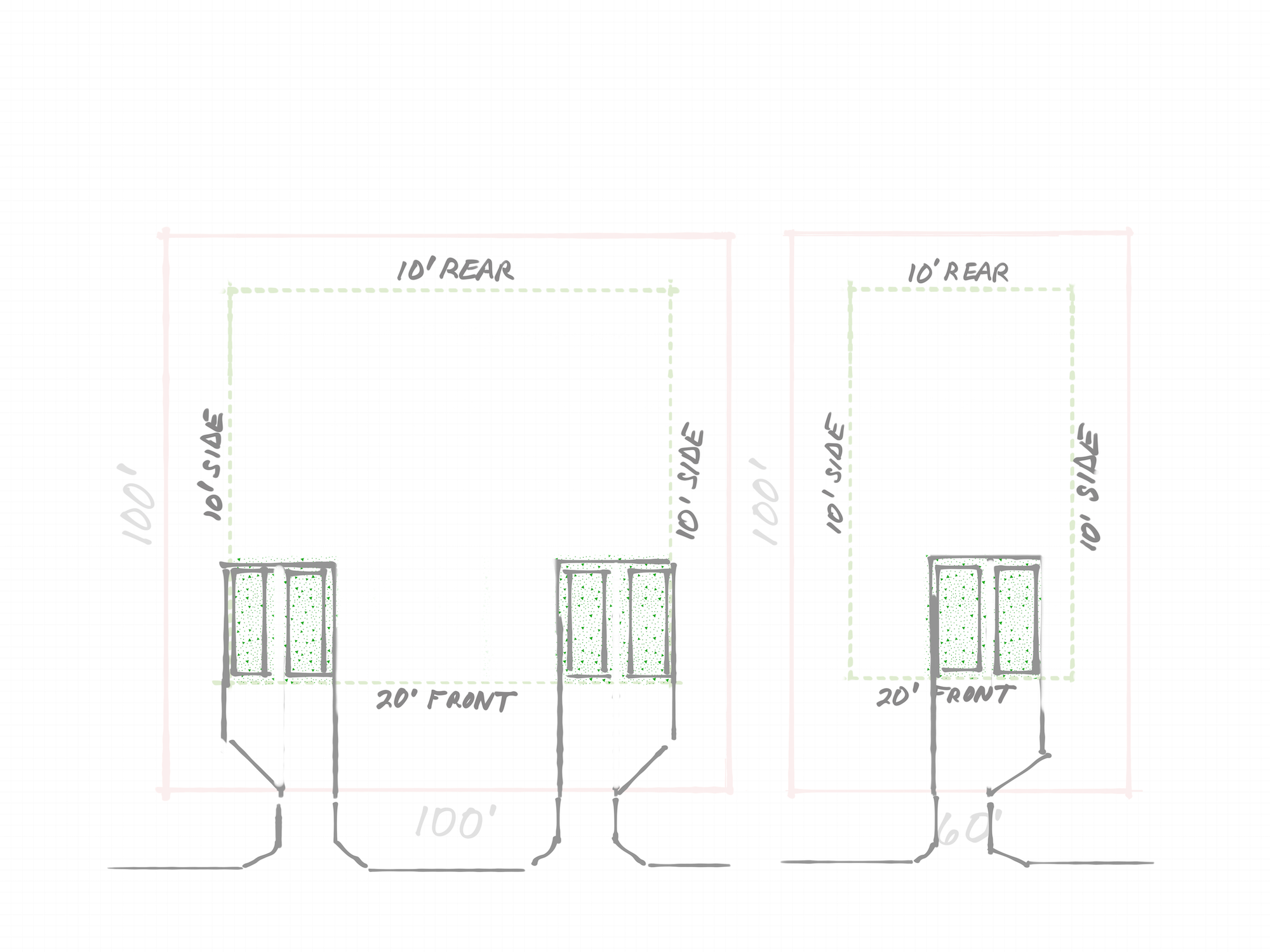
Parking is often required to be within the buildable area, and space is allowed for the driveway.
Parking is part of zoning—even when it doesn’t look like it
Parking requirements are typically embedded within zoning codes, but they behave like a separate layer of constraint.
They determine how many spaces are required per unit or per use, and in many jurisdictions they also regulate where those spaces can be located.
In some cases, parking must be fully accommodated on-site. In others, it can be integrated under a building, placed to the side, or even partially located within certain setback areas depending on the code.
The important point is that parking is not just a functional requirement—it is a spatial one.
And on many small or constrained sites, parking becomes one of the primary drivers of building form and density.
Zoning doesn’t just control use—it controls the buildable envelope
When all zoning components are combined—use, density, setbacks, height, and parking—they define something more important than any single rule.
They define the actual buildable envelope of the property.
This is the three-dimensional space within which any viable design must fit.
Once that envelope is understood, many assumptions about a property begin to change.
A site that looked flexible may become tightly constrained.
A site that looked limited may reveal more opportunity than expected.
The difference is not the property itself.
It is the zoning applied to it in full context.
This is where feasibility begins
Understanding zoning is the first step in any feasibility study because it establishes the boundaries of what is physically and legally possible.
Before design.
Before engineering.
Before financial modeling.
It defines the range of outcomes that can actually be considered.
And without that understanding, even the best design concept is built on assumptions rather than reality.
What comes next
Zoning is only the beginning of the process.
Once the framework is understood, the next step is to look at the rules that quietly reduce buildable area even further—starting with Floor Area Ratio (FAR), which often determines how much building can exist within the zoning envelope.
That is where the next layer of feasibility begins.
If you’re considering purchasing a property for a small-scale development, redevelopment, duplex, or missing middle housing project, a Feasibility Study can help clarify what is realistically possible before you commit to a purchase.
It provides a clear understanding of what the site can actually support—before you move forward with design or investment decisions.
If you’d like us to take a look at a specific property, feel free to reach out and we can walk you through the process.