

Before You Buy: How FAR Limits What You Can Actually Build
Once zoning is understood, most investors assume the next step is straightforward: calculating how much building the site can support.
But this is where another layer of control appears—one that is often misunderstood even by experienced developers.
It is called Floor Area Ratio, or FAR.
And unlike setbacks, parking, or use restrictions, FAR is purely mathematical.
It defines the total allowable building area on a site, regardless of how much space appears to be physically available.
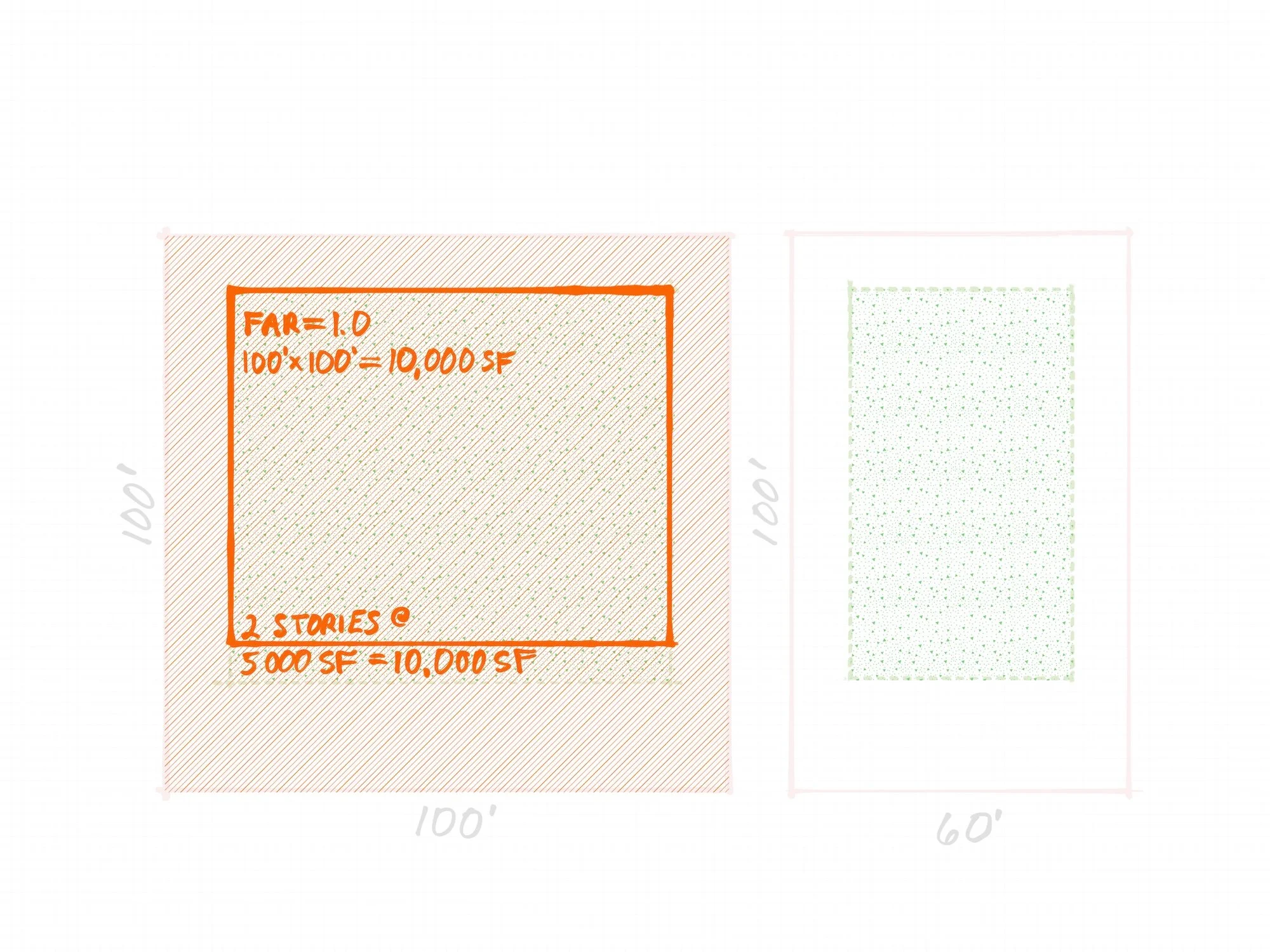
With a FAR of 1.0, this 2-story building covers most of the buildable area.
FAR is not about the size of the lot—it is about total building capacity
Floor Area Ratio is a simple concept:
It is the relationship between the size of the land and the total allowable building floor area.
For example:
A FAR of 0.5 means the total building area across all floors cannot exceed half the size of the lot
A FAR of 1.0 means the total building square footage cannot exceed the size of the lot
On paper, this seems straightforward.
In practice, it often changes the entire direction of a project.
Because FAR does not respond to how a site looks, how it is shaped, or how much open space exists. It only responds to the allowable ratio defined in the zoning code.
That means a site that appears large and flexible may still have a very specific—and sometimes limited—maximum building size.
FAR is often the first moment “potential” becomes a real number
When investors evaluate a property visually, they often think in terms of what physically fits on the site.
FAR shifts that thinking.
It is no longer about footprint or layout.
It becomes about total allowable square footage across all floors.
This is where initial development concepts often begin to change.
Not because the idea is wrong, but because the allowable building capacity is smaller—or sometimes different—than expected once the math is applied.
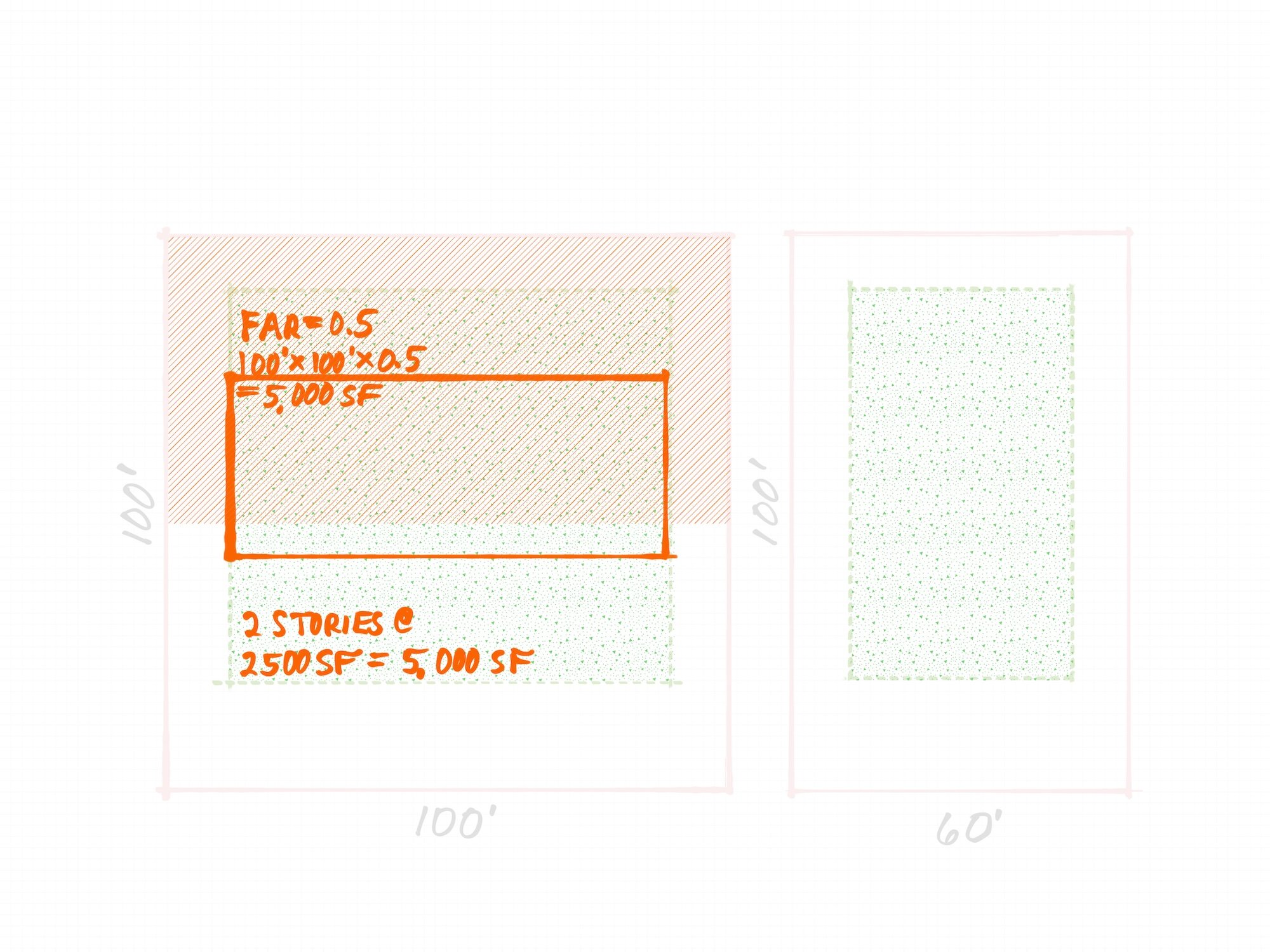
With a FAR of 0.5, this 2-story building covers less than half of the buildable area. A 1-story building would cover most of the entire buildable area.
FAR forces trade-offs between footprint, height, and form
Because FAR limits total square footage, it directly influences building form.
The design must distribute allowable area across:
building footprint
number of stories
open space on the site
A smaller footprint often requires additional height to achieve the same total square footage.
A larger footprint may reduce building height but consumes more of the site.
FAR does not dictate which approach must be used, but it forces a balance between them.
That balance becomes one of the key early decisions in feasibility thinking.
Important clarification: what FAR actually includes
It is also important to understand that FAR is not calculated the same way everywhere.
Each zoning code defines what counts toward the total floor area, and those definitions can vary significantly between jurisdictions.
In many cases, FAR is based primarily on conditioned building area—meaning enclosed, climate-controlled space.
But other jurisdictions expand what is included in the calculation. Depending on the local code, FAR may also include:
Utility and storage areas
Balconies and porches
Garages and carports
These differences can have a meaningful impact on what is actually allowed on a site.
A design that appears compliant in one jurisdiction may exceed FAR limits in another simply due to how the code defines included space.
This is why FAR cannot be applied as a universal rule—it must always be interpreted within the specific zoning code governing the property.
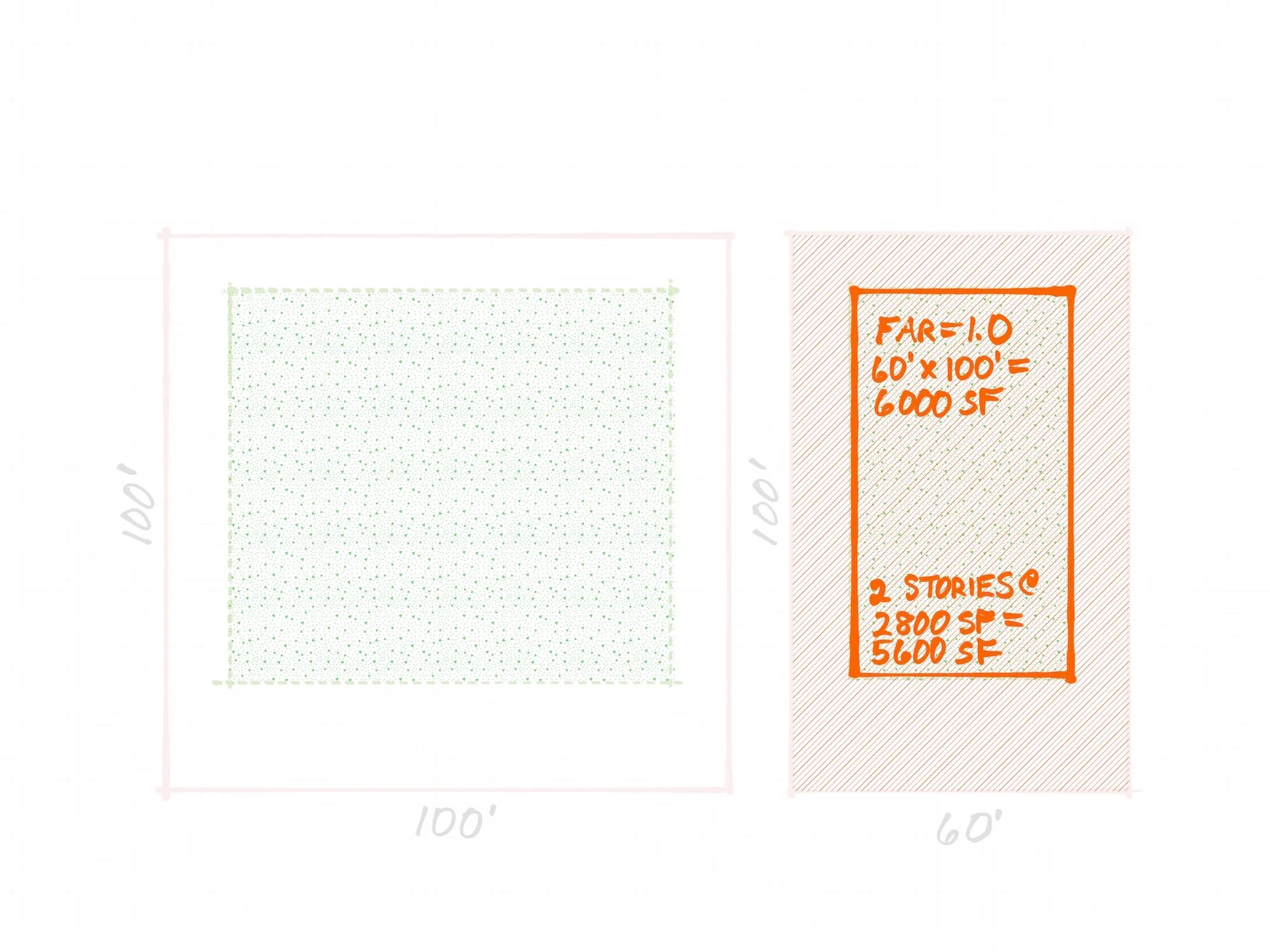
With a FAR of 1.0, this 2-story building covers all of the buildable area, and could potentially have a full or partial 3rd story.
Why FAR matters more than it appears
FAR is often overlooked because it does not show up physically on a site.
You can see setbacks on a survey.
You can see parking requirements in a zoning table.
But FAR exists only as a calculation.
Because of that, it can quietly change the viability of a project before design even begins.
A property that seems capable of supporting multiple units may only support fewer once FAR is applied.
Or in some cases, FAR may allow more square footage than expected—but only if the building is carefully configured across height and footprint.
Either way, it becomes a defining factor in early feasibility decisions.
FAR always works together with zoning
FAR does not replace zoning—it works within it.
Zoning defines what is allowed on a site in terms of use, density, setbacks, height, and parking.
FAR defines how much total building area is available within those constraints.
The two must always be evaluated together.
A site is never defined by a single rule.
It is defined by how all rules interact.
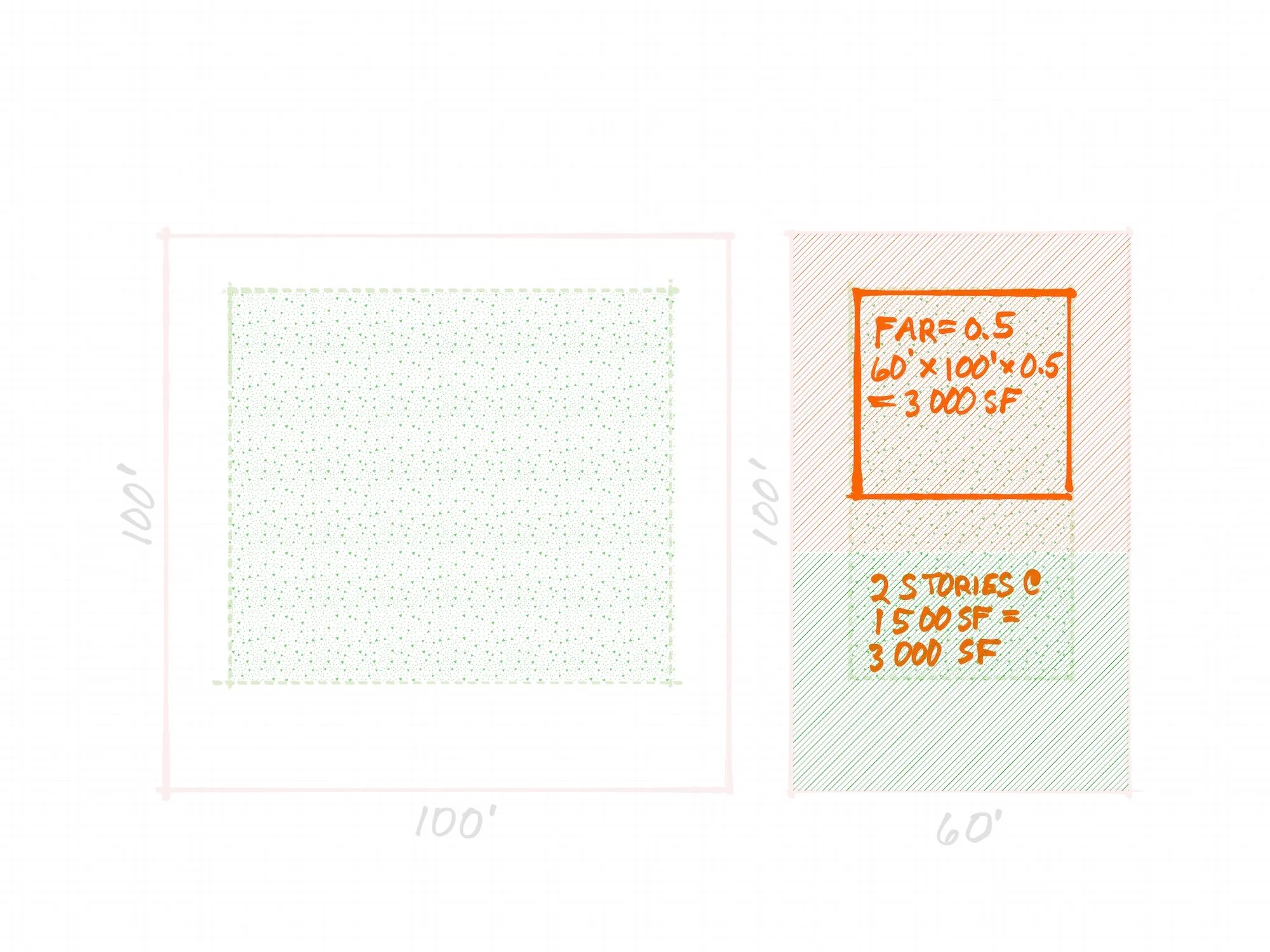
With a FAR of 0.5, this 2-story building covers only half of the buildable area. A 1-story building would cover the entire buildable area.
This is where buildable area starts to take shape
Once FAR is understood in context, it becomes possible to begin estimating:
total allowable square footage
potential unit sizes
realistic building massing
overall development yield
But FAR is still only one part of the feasibility picture.
Even if the total building area works, the site may still be constrained by coverage limits, parking requirements, or environmental restrictions.
That is where the next layer comes in.
What comes next
FAR defines how much can be built.
But another rule determines how much of the site can actually be covered by buildings, driveways, and other impervious surfaces.
That constraint is called Impervious Surface Ratio (ISR).
And in many cases—especially in Florida—it becomes just as limiting as FAR itself.
If you’re considering purchasing a property for a small-scale development, redevelopment, duplex, or missing middle housing project, a Feasibility Study can help clarify what is realistically possible before you commit to a purchase.
It provides a clear understanding of what the site can actually support—before you move forward with design or investment decisions.
If you’d like us to take a look at a specific property, feel free to reach out and we can walk you through the process.